
🇮🇹 Italy
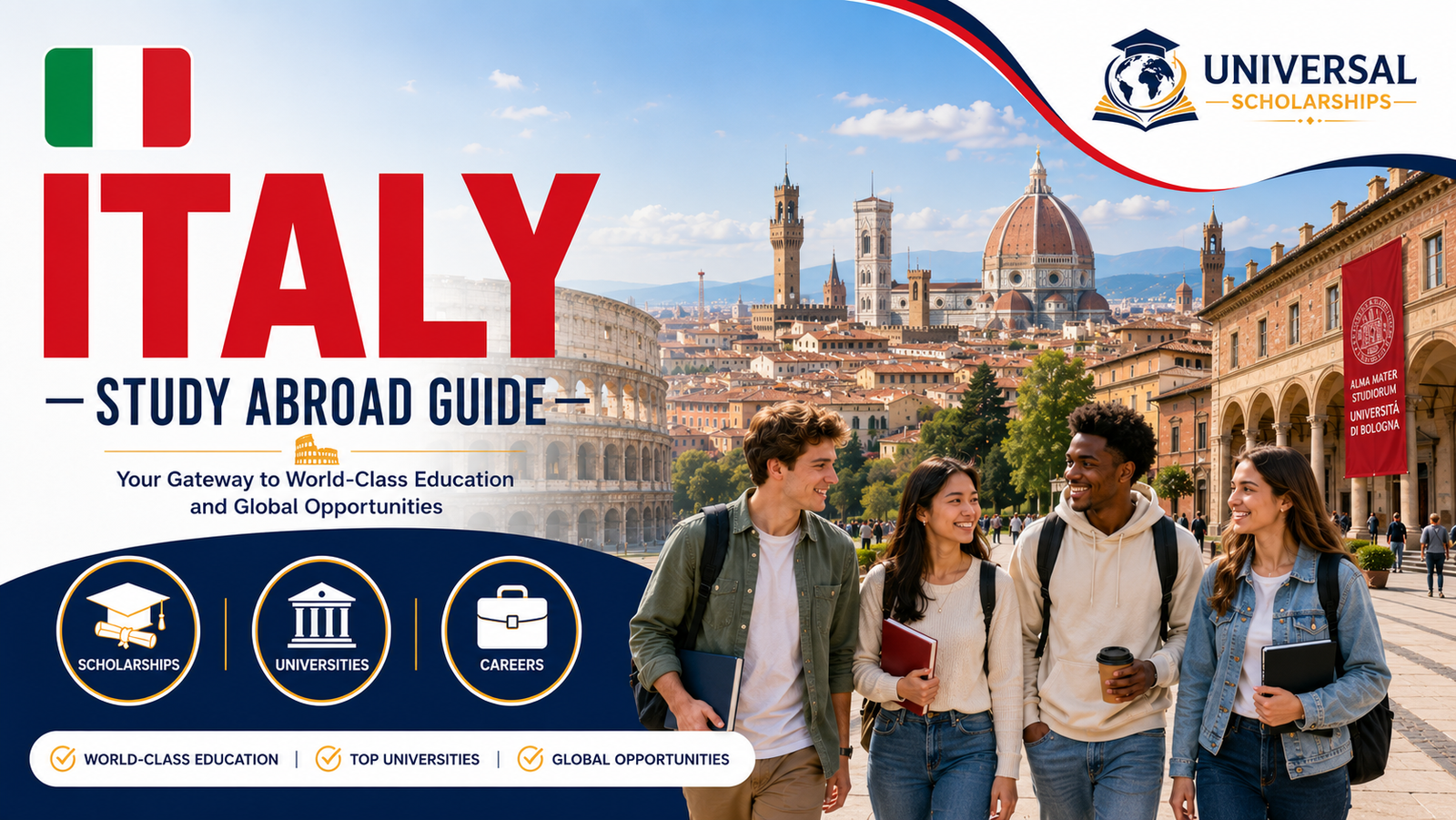
About Italy
If you have ever started an Italy university application, you probably noticed one thing very quickly: the difficult part is not finding a university. The difficult part is understanding what comes first, which documents need to be prepared, when scholarships open, how Universitaly works, and when you should start the visa process.
That is exactly where many international students lose time.
If you are planning to Study in Italy, the good news is that the process becomes much easier when you treat it as a sequence rather than trying to do everything at once. You normally start by choosing your degree and university, prepare your academic and financial documents, apply for admission, complete pre-enrolment through Universitaly when required, apply for scholarships separately, and then move toward the student visa.
For the 2026/27 academic year, Italy’s official international-student procedures are also being used for 2027/28, so students planning ahead can already understand the basic framework. However, individual university admission deadlines and scholarship calls can change from one academic year to another.
Important: This guide is written for international students, especially students applying from outside the EU. Always check the university, scholarship authority and Italian diplomatic mission responsible for your country before submitting anything.
Why Study in Italy?
One reason I regularly see students consider Italy is the combination of internationally recognized universities, a wide range of programmes and several different forms of financial support.
Italy is not simply a destination for art, architecture or tourism-related studies. International students can find programmes in areas such as:
- Business and Management
- Finance and Economics
- Computer Science and Artificial Intelligence
- Engineering
- Architecture
- Medicine and Health Sciences
- Data Science
- International Relations
- Social Sciences
- Design and Fashion
- Biotechnology
- Environmental Sciences
- Humanities and Languages
You can find Bachelor’s, Master’s, single-cycle Master’s, PhD and other higher-education options, depending on the institution and programme. For visa-required students, the exact pre-enrolment procedure depends on the type of course.
Another practical advantage is that public universities generally have lower tuition costs than many private institutions, while tuition can depend on factors such as the university, degree programme and family economic situation. Some universities also provide fee exemptions or scholarships.
A practical point student often misses
Do not choose a university only because somebody on social media says it is “cheap” or “easy to get admission.”
Look at the total picture:
- Tuition fee
- Application fee
- Language requirement
- Admission deadline
- Scholarship deadline
- City and accommodation costs
- Visa requirements
- Whether your academic qualification is accepted
- Whether the programme is actually taught in English or Italian
That checklist can save you from making an expensive mistake later.
Study in Italy: Who Can Apply?
There is no single nationality list for admission to Italian universities. International students from many countries can apply if they meet the academic, language and other requirements of their chosen programme.
For students who require a visa, the university and programme must follow the relevant international-student procedures, and the visa decision itself remains with the Italian diplomatic-consular authority. University admission or Universitaly validation does not automatically guarantee a visa.
Students from Pakistan
Pakistani students can apply to Italian universities and to many university or regional scholarship opportunities, subject to the individual programme and scholarship requirements.
However, there is an important distinction regarding the Italian Government’s MAECI scholarship.
For the 2026/27 MAECI call, the official eligible-country list did not include Pakistan. So Pakistani students should not assume that the MAECI scholarship is available simply because they are applying to Italy. The list must be checked every year.
This is a good example of why copying a scholarship list from an old Facebook post can cause problems.
Study in Italy: Admission Requirements
The requirements vary by university and programme, but international applicants commonly need:
- Valid passport
- Previous academic certificates
- Academic transcripts
- Degree certificate for Master’s applications
- CV, where required
- Motivation letter or personal statement, where required
- Recommendation letters, where required
- English or Italian language proof
- Passport-size photograph, where required
- Programme-specific test or entrance exam, where applicable
- Proof of application fee payment, if applicable
- Additional qualification documents requested by the university
For foreign qualifications, the university decides how the qualification is assessed for admission. Depending on the institution and programme, you may be asked for a Declaration of Value (DoV) or CIMEA documentation. The university should tell you what is required for your particular case.
IELTS and English requirements
Do not assume that every Italian university has the same IELTS rule.
Some programmes require a specific CEFR level such as B2. Others may accept alternative evidence depending on their rules.
For example, the University of Padua states that the specific admission call determines whether B1 or B2 English is required and how the requirement can be demonstrated.
So, if your previous degree was taught completely in English, do not immediately pay for IELTS without checking the exact programme requirements first.
This is one of the most common unnecessary expenses I see students make.
Step-by-Step Process to Study in Italy
The easiest way to understand the process is to divide it into stages.
Step 1: Select your degree and university
Start with the course, not the scholarship.
Use official university websites and Universitaly to research programmes.
Make a shortlist of around 5–8 suitable programmes rather than applying randomly to 20 universities.
For every programme, record:
- University
- Programme name
- Teaching language
- Tuition fee
- Application fee
- Admission requirements
- Deadline
- Scholarship options
- IELTS/English requirement
- Entrance test, if any
- Visa/pre-enrolment requirements
For this, a basic Google Sheet is sufficient.
Step 2: Check your academic eligibility
Compare your previous education with the university’s requirements.
For a Master’s degree, universities may check:
- Your Bachelor’s degree
- Relevant subjects
- Credit distribution
- GPA/percentage
- English proficiency
- Programme-specific academic background
For Bachelor’s applicants, the university may evaluate your secondary education and may require an entrance test for certain programmes.
For example, the University of Padua uses programme-specific admission notices and, for some courses, admission tests such as TOLC.
Step 3: Prepare your documents early
This is where I recommend students slow down instead of rushing.
Create a folder on your laptop and another backup in Google Drive.
Use folders such as:
- Passport
- Academic Documents
- Transcripts
- English Language
- CV
- Motivation Letter
- Recommendation Letters
- Financial Documents
- Scholarship Documents
- Visa Documents
Scan everything clearly.
Do not wait until you receive admission to start collecting family financial documents if you intend to apply for a need-based regional scholarship.
Step 4: Apply to the university
Submit your application through the university’s official platform.
Some universities have several application rounds, while others have programme-specific deadlines.
For example, the University of Padua opened its first 2027/28 application call on 15 September 2026 for most degree programmes.
This is why students planning for 2027 should already be researching universities instead of waiting until spring.
Step 5: Receive the admission decision
If the university accepts you, carefully check whether your offer is:
- Fully unconditional
- Conditional
- Subject to missing documents
- Subject to final qualification
- Subject to language proof
- Subject to payment
Do not simply save the admission letter and move on.
Read every condition.
Step 6: Apply for scholarships separately
This is another area where students get confused.
University admission and scholarship applications are not always the same application.
For example, the Study in Italy FAQ explicitly explains that applying for a MAECI grant and enrolling at a university are two separate procedures.
The same principle applies to many regional scholarships.
Scholarship Opportunities to Study in Italy
Italy has several scholarship routes, and they work differently.
1. Regional scholarships
For many international students, regional right-to-study scholarships are especially important.
Examples include:
- EDISU Piemonte6 — Piedmont/Turin
- ER.GO — Emilia-Romagna
- Lazio DiSCo — Lazio/Rome
- DSU Toscana — Tuscany
- ADISU Umbria — Umbria
These can include combinations of financial support, accommodation, meals and tuition-related benefits, depending on the regional authority and the student’s status.
For example, EDISU Piemonte’s 2026/27 scholarship application for Bachelor’s and Master’s students ran from 22 July to 4 September 2026, with accommodation requested alongside the scholarship application.
ER.GO’s 2026/27 scholarship application opened on **23 June 2026** and closed on **24 August 2026 at 16:00**.
For Lazio DiSCo, the first phase of the 2026/27 right-to-study application closed on 22 July 2026, while students who had not yet enrolled could still participate subject to the conditions and later enrolment deadlines in the call.
DSU Toscana’s 2026/27 scholarship and accommodation application deadline for Bachelor’s, Master’s and single-cycle Master’s students was 7 September 2026 at 13:00.
ADISU Umbria’s 2026/27 scholarship application deadline was 2 September 2026 at 12:00, with published income thresholds of €28,339.88 for ISEE and €61,608.48 for ISPE.
The important lesson
Do not treat “DSU scholarship” as one single national scholarship.
The authority depends on where you study.
For example:
Turin → EDISU Piemonte
Bologna/Emilia-Romagna → ER.GO
Rome/Lazio → Lazio DiSCo
Tuscany → DSU Toscana
Umbria → ADISU Umbria
Check the most recent call for your area at all times.
Italy Regional Scholarships 2027: Eligibility, Benefits & Universities
2. University scholarships
Universities themselves can offer merit-based scholarships and tuition waivers.
One useful example is the Padua International Excellence Scholarship. For 2026/27, the University of Padua offered up to 68 scholarships, with a gross value of €8,000 per year plus exemption from student fees, subject to the programme and scholarship conditions.
Ca’ Foscari University of Venice also offers financial support for high-achieving international students. Its 2027/28 information currently lists 8 Bachelor’s scholarships of €10,000 per year for three years and 20 Master’s scholarships of €10,000 per year for two years, subject to the official call and eligibility requirements.
These are examples of why it is worth checking the university’s own scholarship page instead of relying only on general scholarship websites.
3. MAECI Italian Government Scholarships
The Italian Government also offers MAECI scholarships through the Study in Italy portal.
For 2026/27, eligible programmes included Master’s degrees, AFAM programmes, PhD programmes, research projects and intensive Italian language and culture courses. The application deadline was 26 March 2026 at 14:00 Italian time.
The 2026/27 call provided a total scholarship value of up to €10,800 for the main nine-month study programmes, paid in instalments subject to the scholarship conditions.
But remember the country-list issue mentioned earlier: eligibility depends on the official annual list.
Documents You Should Prepare for Scholarships
Compared to university entry, need-based regional scholarships may demand a lot more financial verification.
International students may need documents concerning:
- Family composition
- Parents’ income
- Property ownership
- Bank/financial assets
- Employment or business income
- Household information
- Academic enrolment
- Passport
- Residence information
- Rental/accommodation information
For international students, documents may need translation, legalization or other verification depending on the regional authority.
This is why I recommend preparing financial documents months before the scholarship deadline.
A student can have a strong academic profile and still miss a scholarship because the financial documentation was incomplete.
Italy Study Visa: From Admission to Visa
Once you have admission and your university has completed the required validation of your pre-enrolment, the next major stage is the visa.
For students requiring a visa, pre-enrolment is generally completed through **Universitaly**. The Italian Embassy in Islamabad specifically states that students whose Universitaly pre-enrolment has been validated by their university can proceed with the visa application process.
Step 1: Complete Universitaly pre-enrolment
Create your profile and enter your:
- Personal details
- Passport information
- University
- Degree programme
- Previous education
- Other requested information
Upload the required documents and submit the pre-enrolment application.
The university reviews and validates it.
Step 2: Prepare the visa file
Your exact checklist depends on your nationality and consular jurisdiction, but typical requirements can include:
- Visa application form
- Valid passport
- Passport photographs
- University admission/pre-enrolment documentation
- Validated Universitaly summary
- Academic documents
- Declaration of Value or CIMEA documentation, where required
- Proof of accommodation
- Proof of sufficient financial means
- Health insurance
- Travel documentation
- Language proof where required
- Sponsorship/financial documents where applicable
The Italian authorities emphasize that the exact documentation must be checked against the applicable procedures and local diplomatic mission.
Financial proof is important
Do not think that simply having a scholarship application or an admission letter automatically solves the financial requirement.
The visa authority evaluates whether you have adequate financial resources for your stay.
The exact amount can change according to the applicable rules and local checklist. Some current Italian consular guidance for 2026/27 uses around €10,179.85 per year, while older official guidance used a lower amount, which is why copying an old visa checklist from a consultant’s website is risky.
For applicants in Pakistan, always follow the current checklist and instructions issued by the Italian Embassy/Consulate responsible for your residence.
Step 3: Submit the visa application
For applicants under the Islamabad Embassy’s jurisdiction, visa application collection is handled through BLS-Intiana centers in Islamabad, Lahore, Multan and Faisalabad. Karachi and Quetta fall under the Italian Consulate General in Karachi.
The Embassy of Italy in Islamabad also warns applicants that neither the Embassy nor BLS-Intiana has an official WhatsApp/mobile number for selling or arranging study-visa appointments and advises students to be cautious about fraudulent requests for deposits or commissions.
That warning is worth taking seriously.
Current Pakistan deadline
For the 2026/27 academic year, the Italian Embassy in Islamabad states that the deadline for the relevant student visa applications is 30 November 2026. Only students whose university has validated the Universitaly pre-enrolment can submit the visa application under the stated procedure.
Do not use this date as a universal deadline for every future intake. For your academic year, review the official Embassy guidelines.
What Happens After You Reach Italy?
The procedure does not finish with obtaining the visa.
After entering Italy, students staying for longer periods normally need to apply for a Permesso di Soggiorno (residence permit).
Italian government guidance states that students entering Italy for university study should apply for the residence permit within 8 days of entering Italy.
Your residence permit becomes important for legally staying in Italy beyond the initial visa period.
Students holding a study residence permit can also work part-time for up to 20 hours per week and 1,040 hours per year, subject to the applicable rules.
How Long Does the Italy Application Process Take?
A realistic plan is to start 8–12 months before your intended intake.
Around 8–12 months before intake
- Research universities
- Select programmes
- Check academic eligibility
- Check English/Italian requirements
- Research scholarships
- Start financial documentation
Around 6–9 months before intake
- Prepare CV
- Prepare motivation letter
- Obtain recommendation letters
- Prepare translations/legalisation where required
- Apply to universities as their application rounds open
Around 4–7 months before intake
- Receive admission decisions
- Apply for regional/university scholarships
- Complete missing academic requirements
- Prepare financial and accommodation documents
Around 2–4 months before travel
- Complete Universitaly pre-enrolment
- Wait for university validation
- Prepare final visa file
- Follow the relevant Embassy/BLS process
Final weeks before travel
- Receive visa
- Arrange accommodation
- Book travel only when appropriate
- Carry original documents
- Prepare for arrival and residence-permit procedures
This is a planning framework, not a guaranteed processing schedule. University admission, scholarship decisions, Universitaly validation and visa appointments can all happen on different timelines.
Common Mistakes Students Make When Applying to Italy
1. Waiting for the scholarship before applying to university
This is probably one of the biggest mistakes.
Scholarship deadlines and university deadlines are often different.
Apply for the university according to its admission deadline and apply for the scholarship according to its own call.
2. Assuming every Italian university accepts MOI
Some universities or programmes may accept previous English-medium education as evidence, while others require a recognised language certificate.
Check the actual programme page.
3. Using an old scholarship deadline
A regional scholarship deadline can change every year.
The 2026/27 deadlines above are useful examples, but they should not automatically be copied into a 2027/28 application.
4. Preparing financial documents at the last minute
For international students, family-income and property documentation can take considerable time.
Start early.
5. Getting a “guaranteed visa” via paying an agent
There is no legitimate person who can guarantee that an Italian consular authority will issue your visa.
The official Universitaly procedure itself states that university validation does not guarantee visa issuance.
6. Choosing a university only because it has a low tuition fee
A €500–€1,000 difference in tuition may not matter if the city has significantly higher accommodation and living costs.
Look at the complete budget.
To study in Italy, who should apply?
Italy can be worth considering if you:
- Want a Bachelor’s, Master’s or PhD in Europe
- Have a suitable academic background
- Can meet the programme’s language requirements
- Are prepared to organize documents carefully
- Want to explore regional or university scholarships
- Can demonstrate the financial resources required for the visa
- Are comfortable managing several separate application processes
- Are willing to start months before the intake
It may not be the right choice if you are looking for a destination where one application automatically covers admission, scholarship and visa. Italy generally requires you to manage these stages separately.
A Simple Study in Italy Checklist
Before submitting anything, ask yourself:
☐ Have I selected the correct degree programme?
☐ Does my previous education meet the entry requirements?
☐ Is the programme taught in English or Italian?
☐ Do I need IELTS or another language certificate?
☐ Is there an application fee?
☐ Have I checked the university deadline?
☐ Have I checked the scholarship deadline separately?
☐ Have I prepared family financial documents?
☐ Do I need CIMEA or Declaration of Value?
☐ Have I completed Universitaly correctly?
☐ Has my university validated the pre-enrolment?
☐ Have I checked the current visa checklist for my country?
☐ Do I have appropriate accommodation evidence?
☐ Have I planned enough time for the visa process?
☐ Do I know what to do after arriving in Italy?
If you can answer these questions confidently, your application is much more organized.
Frequently Asked Questions
Is Italy good for international students?
Italy offers a wide range of Bachelor’s, Master’s, PhD and other higher-education programmes, including many programmes taught in English. Students can also explore university and regional financial-support opportunities.
Is it possible for foreign students to receive scholarships in Italy?
Yes. Options can include regional right-to-study scholarships, university scholarships, tuition waivers and government programmes such as MAECI. Eligibility and deadlines are different for each scheme.
Can Pakistani students’ study in Italy?
Yes. Pakistani students can apply to Italian universities if they meet the academic, language and other requirements. However, scholarship eligibility is separate. For example, Pakistan was not included in the 2026/27 MAECI eligible-country list, so students should focus on the specific scholarships for which their nationality is eligible.
Do I need IELTS to study in Italy?
Not necessarily for every programme. Language requirements are programme-specific. Some universities may accept alternative forms of proof, depending on their rules. Always check the official admission call before booking an English test.
Do I apply for the scholarship before admission?
It depends on the scholarship. Some regional scholarships allow students who intend to enrol to apply, while university scholarships may be connected directly to the admission application. Never assume that one rule applies to all scholarships.
When should I begin applying to Italy?
For a September/October intake, starting around 8–12 months earlier gives you much more room to handle admission, documents, scholarships and visa preparation.
What is the Italy student visa deadline?
For 2026/27 university enrolment, the Italian Embassy in Islamabad stated 30 November 2026 as the deadline for the relevant student visa applications. Future academic years should be checked against the latest Embassy and Universitaly instructions.
Can I work while studying in Italy?
A study residence permit allows part-time work up to 20 hours per week and 1,040 hours per year, subject to Italian rules.
Final Thoughts
The biggest lesson I would give any student planning to study in Italy is simple: do not leave everything until you receive an admission letter.
The strongest applications are usually the ones where the student has already thought about the next three steps.
While applying for admission, think about the scholarship.
While preparing the scholarship documents, think about Universitaly.
While waiting for Universitaly validation, prepare the visa file.
And while preparing the visa, start thinking about accommodation and your first few weeks in Italy.
That approach feels much less stressful than trying to solve everything one deadline at a time.
Italy has genuine opportunities for international students, but the process rewards students who are organized, patient and careful with official requirements.
Official portals to check before applying: Universitaly, Study in Italy/MAECI, the university’s official admissions page, your regional scholarship authority and the Italian Embassy/Consulate responsible for your residence.
Suggested internal links for Universal Scholarships:
- Italy Regional Scholarships 2027: Eligibility, Benefits & Universities
- Italy Study Visa Checklist
- Study in Europe Guide
- Scholarships in Italy for International Students
Information checked against official sources available in September 2026. Deadlines, scholarship rules, financial requirements and university admission conditions can change, so applicants should verify the latest call before submitting an application.
🎯 Scholarships in Italy